A garage door spring breaking feels sudden — but it rarely is. In most cases, the spring has been giving signals for weeks or months.
Knowing what to watch for means you catch the problem early, on your schedule, instead of finding out when you are late for work and the car is trapped inside the garage.
1. The Door Feels Heavier Than Usual
Disconnect the opener and try lifting the door manually. It should feel light — the springs are supposed to do the work, not you.
If it feels heavy, strains to move, or will not stay open at waist height, the spring tension is failing. Do not keep running the opener. The extra load can damage the motor.
2. You Hear a Loud Bang from the Garage
This is the classic spring snap. It sounds like a gunshot or firecracker: sharp, sudden, and unmistakable.
If you hear this, do not open the door. Cables may be under irregular tension, and the door can come down hard.
3. The Door Won't Stay Open at Half Height
This is the balance test. Disconnect the opener, lift the door to waist height, and carefully let go.
A properly balanced door should stay put. If it falls or rises, spring tension is off — one or both springs are either failing or already broken.

4. The Door Opens Crooked or Tilts to One Side
Torsion springs work as a pair. If one loses tension before the other, the door can open unevenly. One side lifts faster, the door tracks crooked, and one cable may go slack.
This puts stress on the tracks and hardware. The longer it runs this way, the more things can bend.
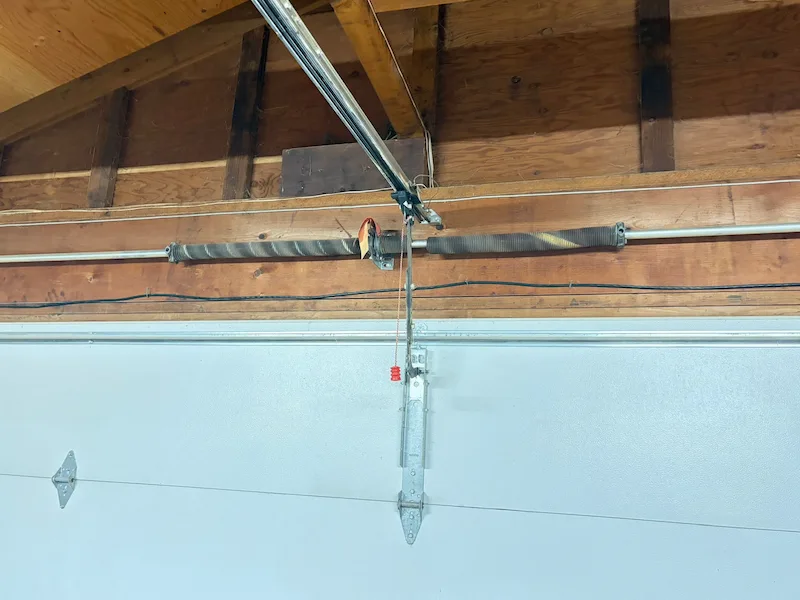
5. You Can See a Gap in the Spring Coil
Look at the spring above your door from a safe distance. Do not touch it.
A visible gap in the coil means the spring has snapped. That is a broken spring, not a spring that needs a little adjustment.
6. The Door Only Opens a Few Inches and Reverses
Modern openers have force-sensing protection. When the opener detects unusual resistance — like trying to lift a door without working springs — it stops or reverses to protect the motor.
If the door starts opening and immediately quits, the opener may not be the real problem. The spring system may be.
7. Rust or Corrosion on the Spring
Rust does not just look bad. It weakens the metal and causes coil binding.
In King County's wet climate, rust on springs is common and predictable on doors that have not been maintained. A heavily rusted spring is closer to failure.
8. Grinding or Popping Sounds During Operation
Metal-on-metal friction, binding coils, or uneven spring tension can all create grinding or popping sounds.
A pop on the way up or a grinding sound during travel is the spring telling you something is wrong. Do not ignore new sounds.
9. The Door Opens or Closes Too Slowly — or Too Fast
A properly balanced door moves at a steady pace. When spring tension fails, the opener has to compensate.
Sometimes that means slow, strained movement. Sometimes it means the door comes down too fast because the spring is no longer controlling the weight correctly. A door that slams shut is a safety hazard.
10. It Has Been 7+ Years Since the Last Replacement
Most garage door springs are rated for about 10,000 cycles. At four cycles a day — two cars, two trips — that is roughly seven years.
If you cannot remember the last time the springs were replaced, or if the house is more than a decade old and you have never replaced them, schedule an inspection before they tell you themselves.
"Jon mentioned there may not be a lot of life left on our springs... He was indeed right, six months later one broke. Jon was able to come out the same day, replace the spring quickly and charge us a very reasonable price."
— Lynn S., RentonWhat to Do When a Spring Breaks
- Stop using the door. Do not operate it manually or with the opener.
- Disconnect the opener from the outlet. This prevents it from running automatically.
- Keep the area clear. Cables and hardware may be under stress.
- Call for same-day service. We carry common spring sizes on the truck.
Spring replacement is not a good DIY gamble. Torsion springs store a serious amount of tension, and the door itself can weigh hundreds of pounds. If you are seeing any of these warning signs, the safest move is to have the system inspected before it fails completely.