Your garage door is probably the largest moving part of your home, and most people don't think about it until it stops working. We've seen everything from Renton to Sammamish to Newcastle. Some problems are one-time failures. Most are predictable, preventable, and fixable fast when you catch them early.
1. Broken Springs
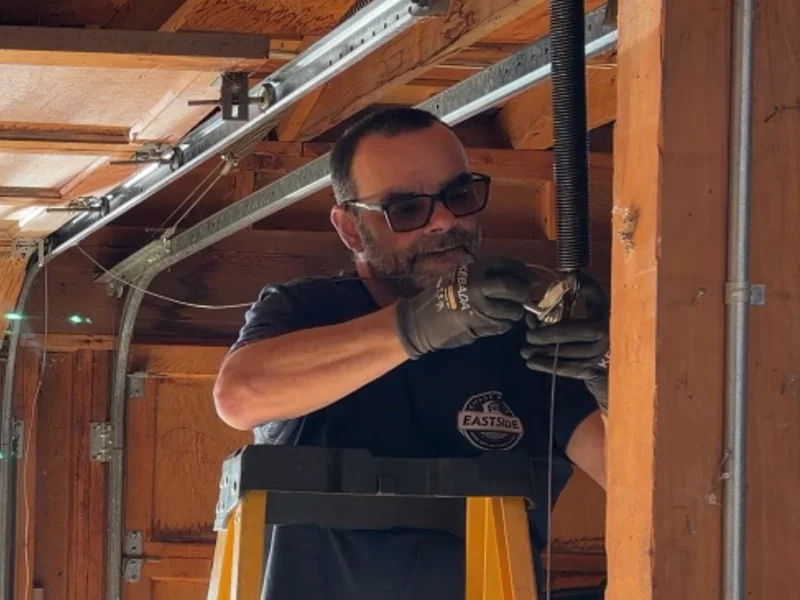
The most common call we get. Springs counterbalance the door's weight — when one snaps, the door feels impossibly heavy and the opener stops to protect itself. You'll hear a loud bang when it goes, or come out to find a door that won't budge. We replace both springs when one breaks — they share the same wear history, and the second one rarely lasts long on its own. See our full guide: garage door spring replacement.
2. Openers That Stop Responding
Openers fail for a range of reasons: worn motor gears, misaligned safety sensors, dead remote batteries, or circuit board failure. Before calling for a full replacement, check the basics — sensors clean and aligned, batteries fresh, power to the unit. If all that checks out and it still won't run, the motor or board may have given out. Older chain-drive openers (10+ years) are often worth replacing with a quiet belt-drive and smart features at this point. See: opener repair.
3. Doors That Won't Close All the Way
Almost always a sensor issue first. The photo-eye sensors at the base of the door detect obstacles — a dirty lens, a spider web, or a slight bump can trigger a false reversal. Clean the lenses, check alignment, confirm both indicator lights are solid. If that doesn't fix it, the issue is likely a travel limit adjustment or failing springs. Full guide: why your garage door won't close all the way.
4. Noisy, Rattling, or Grinding Doors
Noise is almost always mechanical feedback. Rattling is usually loose hardware. Grinding points to worn rollers or dry tracks. Squealing means the bearings or rollers need lubrication or replacement. A noisy door isn't just annoying — it's running with more friction than it should, which accelerates wear on everything else. A tune-up usually resolves it. See: garage door tune-up.
"Came out same day, diagnosed the problem right away, gave a very reasonable quote... got our garage door up and running in no time."
5. The Pacific Northwest Factor
King County's climate is hard on garage door hardware. Moisture gets into bearings and springs. Temperature swings stress metal. Rubber seals crack and harden. We see more spring failures, more rust-related cable wear, and more seal failures per year than our counterparts in dry climates. Seasonal maintenance — ideally in fall before freezing temps arrive — is the most cost-effective thing a King County homeowner can do.
6. Off-Track Doors
A door that's jumped the track is usually the result of a roller popping out, a cable snapping under tension, or a bottom bracket failing. This is one of the more urgent problems — a partially off-track door can come down unpredictably. Don't try to force it back. Call for same-day service. See: off-track repair.
"Came out same day and fixed my garage. Great service." — Steve N., Newcastle